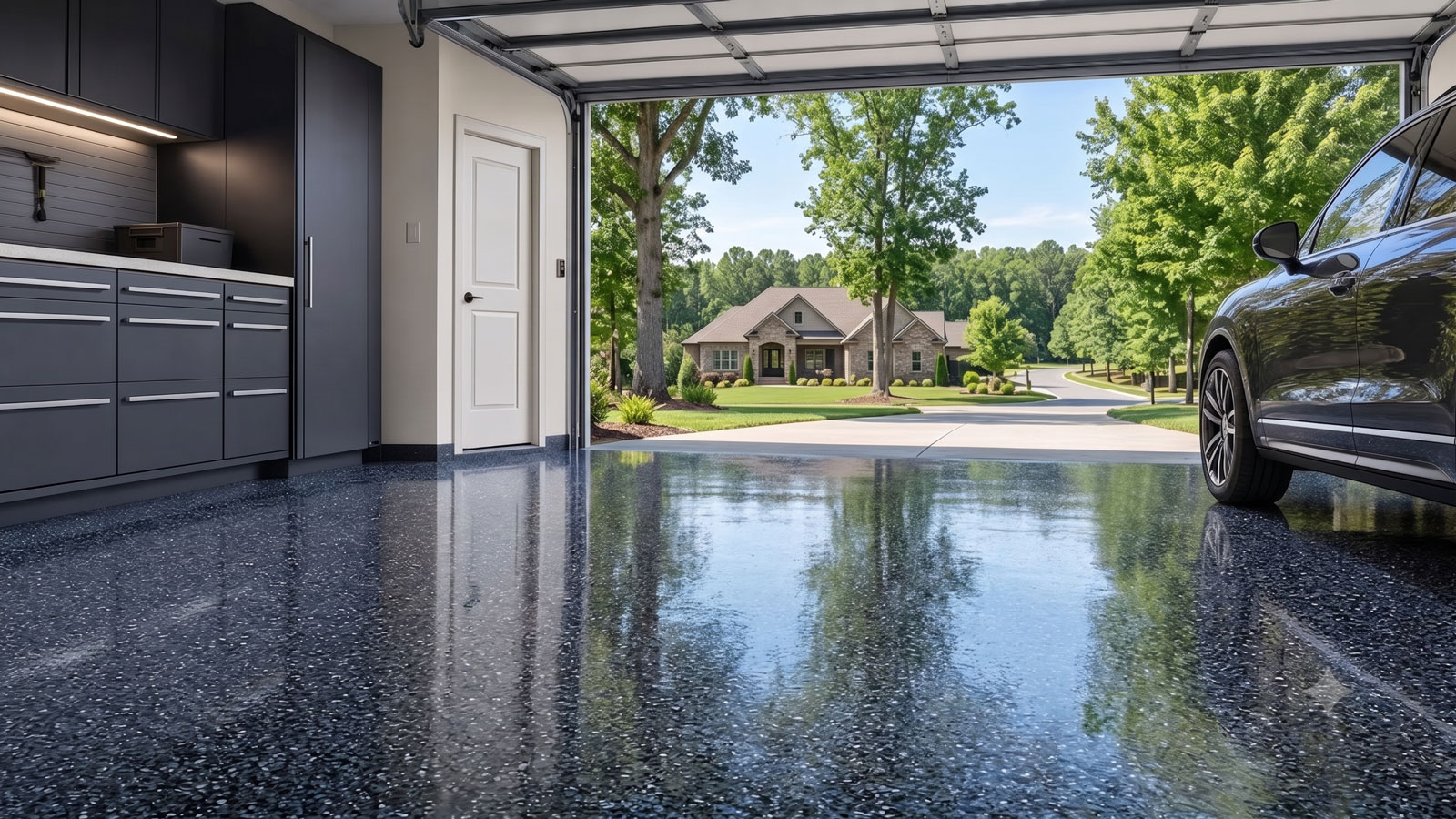
Garage & Commercial Floor Coating in Wallingford, CT
Floor Coating Services in Wallingford, CT
Wallingford is a distinct central Connecticut town along the Quinnipiac River corridor, with long-established residential neighborhoods, commercial corridors and later subdivisions. The town administers land-use planning through its Planning and Zoning Commission and inland wetlands review, including decisions about development near watercourses. Such planning establishes a varied built environment, but it does not tell a homeowner whether a particular garage slab is original, repoured or suitable for a resin coating.
The Quinnipiac River and inland drainage landscape make water pathways worth checking, but proximity to a river does not prove that concrete contains excess moisture. A garage may receive runoff from an uphill driveway or gutter, while another simply collects snowmelt and deicing grit tracked inside by vehicles. Those situations have very different implications: a coating cannot redirect water or repair a moving crack.
Before selecting epoxy, polyaspartic or decorative flake, inspect concrete strength, old paint, vehicle stains, patches, moisture suitability and edges. A well-prepared continuous surface may simplify everyday cleanup, but its durability depends on how the substrate is handled and the conditions during cure. A written bid should state grinding, repairs, texture and return-to-parking timing.
Local Market Insight
Wallingford's Quinnipiac River setting and independently administered inland wetland planning distinguish it from the coastal Sound communities. Older neighborhoods and newer residential development create different potential concrete histories, while snowmelt remains a practical winter-use consideration.
What Affects the Cost of Garage Floor Coating in Wallingford?
Wallingford coating costs should follow actual prior paint, cracks, oil contamination and repairs. River setting and neighborhood age are only reasons to ask more precise inspection questions.
Distinguish outdoor runoff from water tracked in during winter, and make the estimate describe substrate grinding, repairs, complete layers, texture and curing before agreeing on cost.
- Garage history and prior coatings: Some floors may contain paint, older resin or sealers from past renovations. Inspect adhesion and remove incompatible material before new coating.
- Quinnipiac drainage context: A nearby river or wetland does not establish private slab dampness. Check threshold runoff, gutters and actual water history at the property.
- Winter salt and grit: Road-treatment residue can accumulate where cars park. Clean and profile contaminated concrete before coating, and discuss ongoing maintenance afterward.
- Crack and joint treatment: Evaluate stable repairs, pitting and active movement. A decorative finish cannot resolve structural cracks or settlement.
- Garage configuration: Detached buildings, steps, utility fixtures, shelving and narrow entrances can change grinding and edge-work labor. Include clearing and staging.
- Topcoat and schedule: Flake blend, finish texture and application-temperature limits affect price. Confirm when vehicles can safely return under the complete system's cure rules.
Call for a clear, project-specific estimate — or request one online.
Wallingford's Town Planning and Layered Residential Development
Wallingford adopted its Plan of Conservation and Development on June 13, 2016 after public sessions in 2015, including a November 5 Town Center workshop. A separate transit-oriented development plan and market assessment were accepted on July 25, 2016. More recently, a public kickoff on December 11, 2025 began the POCD 2036 process. These documented changes distinguish the Town Center and railroad-station corridor from outlying low-density neighborhoods, but cannot establish any one garage slab's age.
A long-established home can have a detached garage built later or a replacement slab that is decades younger than the house. Newer construction may still have curing agents or sealers that require treatment. Inspect paint, old patches, oil marks, joints and concrete strength before choosing a system.
An installer should explain how mechanical profiling creates an appropriate bondable surface, and how failing existing coatings are removed. Cracks with active movement are not interchangeable with stable cosmetic defects. If concrete is structurally unsound, the problem needs attention before decorative finishing.
Homeowners comparing bids should request written findings, grinding, coating removal, repair work, layer specification and cure restrictions. Those details make estimates comparable across older garages and newer attached bays.
The Quinnipiac River, Threshold Water and Winter Residue
The Quinnipiac River is a defining natural corridor through the Wallingford region, and town land-use procedures include review of inland wetlands and watercourses. Public environmental protections matter for development, but they cannot diagnose the dampness of concrete inside a garage. That determination depends on direct observations and appropriate tests.
After rain or snow, ask where water originates. Slush on vehicle tires is ordinary garage use; water flowing beneath a door from a driveway is a drainage issue; unexplained slab wetness may require product-specific moisture evaluation. The coating contractor should not sell the same fix for all three.
A sound properly installed surface can simplify removal of winter grit and salty meltwater. It cannot stop runoff from a low apron, repair a cracked foundation or change groundwater pressure. Where active water entry is observed, address the cause before spending on resin finishing.
Finish selection then turns to texture, cleaning and cure. Ask for a sample appropriate for wet shoes and cars, and make sure the system's air and concrete temperature restrictions are realistic for the proposed work season.
Frequently Asked Questions
Does being near the Quinnipiac River mean my garage cannot be coated?
No. River proximity alone is not a slab moisture test. Inspect actual water entry and concrete conditions before deciding on a suitable system.
Are old Wallingford garages necessarily difficult to prepare?
No. Concrete may have been repoured later or remain sound, while some newer floors also need sealer removal. Inspect before estimating.
Will epoxy eliminate winter road-salt cleanup?
No. A coated surface may be easier to clean, but vehicles still bring snow, grit and salt indoors and maintenance remains necessary.
Can a coating repair a moving concrete crack?
No. Active movement requires appropriate evaluation and a structural or other repair plan, not merely a decorative topcoat.
What should a Wallingford bid include?
Ask for previous-coating removal, surface grinding, cracks and patches, moisture checks if justified, system layers, texture and vehicle-return instructions.
Wallingford Neighborhoods & Local Context
Typical Project Cost
$3,000–$5,500
Typical range for a two-car garage. Final pricing depends on floor size, concrete condition, prep work, coating type, and finish options.
Helpful Guides
Other Service Areas